
How Different Naha, Okinawa Feels by Day and by Night: Following the Sea and City on Street Kart Through Your Companions' Expressions
How Different Naha, Okinawa Feels by Day and by Night: Following the Sea and City on Street Kart Through Your Companions' Expressions
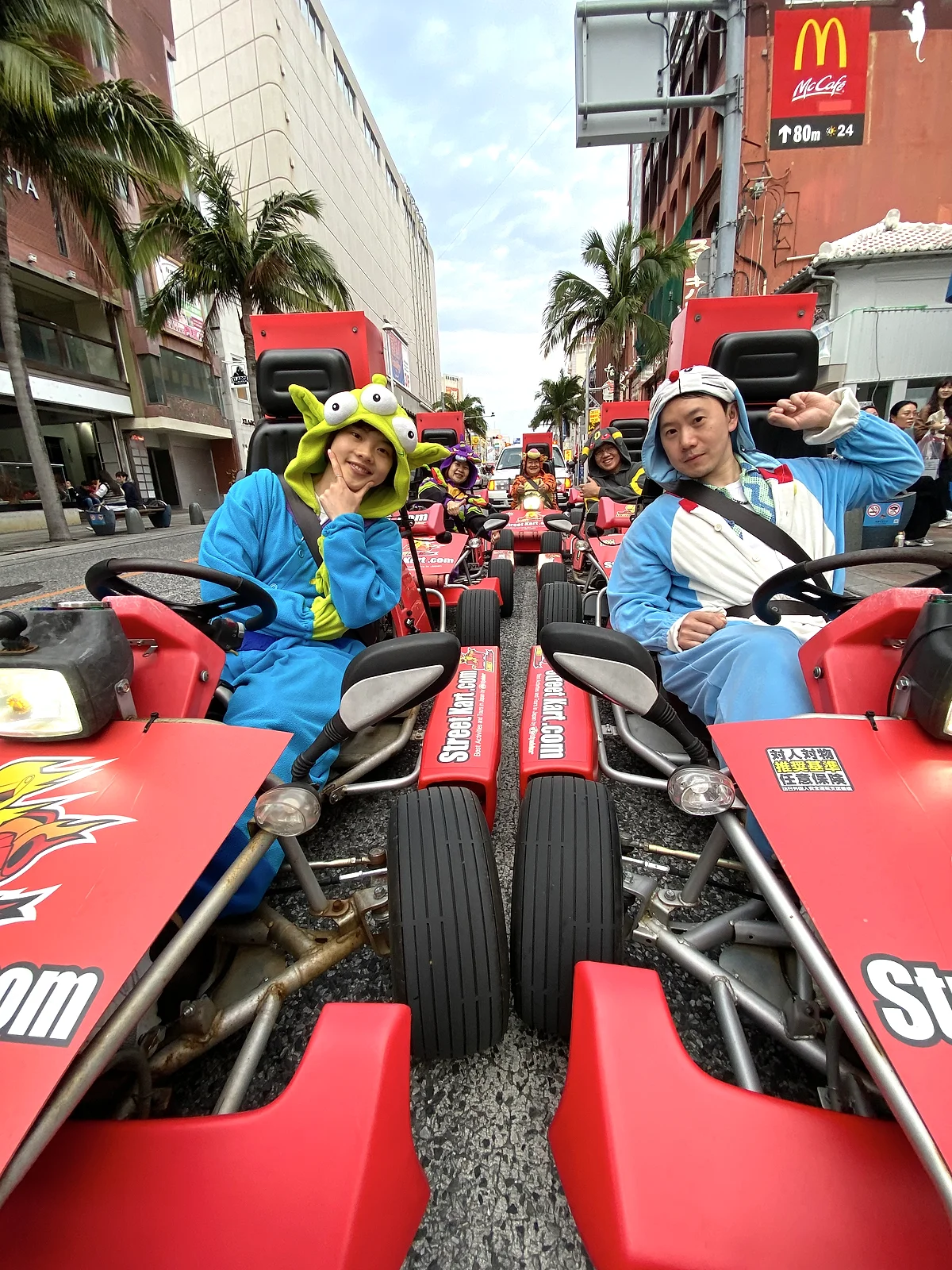
You're stopped at a red light. You glance over, and the face of the friend in the kart next to you looks completely different depending on whether it's day or night.
In Naha by day, they were exclaiming over the color of the sea. In Naha by night, they were quietly watching the city lights.
It's the same city and the same road. Still, the people riding with you react differently depending on the time of day.
This is for anyone who has already been to Okinawa at least once. Let's take our time and trace that difference.
In Naha by day, where do your companions' eyes go?
In daytime Okinawa, the first thing that catches your eye is color.
Driving along the coast, blue stays at the edge of your vision the whole time. The shallows are emerald green, and the blue deepens the farther out you look.
It's a different angle from the sea you watched from the beach on your last trip. This isn't a sea you look down on while sitting on the sand. It's a sea at road level, flowing past beside you.
Depending on the course, you may also pass through Senaga Island. As you approach, Umikaji Terrace comes into view, a row of white buildings. Its whiteness, often called Mediterranean-style, is almost a little dazzling in the strong midday sun.
If your companion loves the sea, this is probably where they start talking more. When you stop at a light, they turn around and say, "Did you see that color just now?" That feels like a very Senaga-Island-by-day reaction.
Around Naha Airport, you can see planes taking off and landing up close. In daytime the sky is bright, so the outlines of the aircraft stand out sharply. If you have a friend who loves planes, they might stay frozen, staring up.
With both the sky and the sea so bright, there's a lot to take in. Daytime Okinawa is a place where you want to react to everything you see.
Once you enter Kokusai Street, the atmosphere suddenly becomes all about people. Along its roughly 1.6 km length are souvenir shops, restaurants, and general stores. After the open feel of the coast, signs and crowds press in from both sides.
Your companions' words change too. From "Wow, it's beautiful" to "Let's check out that shop later." Kokusai Street by day doubles as a chance to scout places to walk to after the ride.
The one thing to watch out for during the day is the sun. Okinawa's sun clings to your skin along with the humidity. Reapply sunscreen before you set off and bring sunglasses. That alone goes a long way toward preventing the kind of exhaustion in the second half that leaves you too worn out to enjoy the scenery.
You'll also want to dress sensibly, not just for the heat. Avoid open-toed sandals, heels, skirts, and dresses; come in sneakers and clothes you can move in. If you show up straight from the beach dressed for it, this is where you'll run into trouble. It's handy to have a drink and a small bag that fits in the kart. The shop has lockers for small items, but they're not suited to large luggage like suitcases. If you're heading there straight from the airport, you'll travel lighter if you drop your big bags at your hotel first.
At night, what changes on the same road?
In Naha at night, the blue of the sea that stood out most during the day almost disappears.
This is where it gets interesting.
Senaga Island and around the airport: when the sea disappears, sound and smell come forward
After sunset, the sea that filled your view during the day becomes a dark expanse.
Once the color is gone, your attention shifts to your ears and nose. The sound of the waves. The smell of salt. The humid night breeze.
The coastline that was a place to "look at" by day becomes a place to "feel" at night.
Your companions tend to go quiet as well. The friend who turned around at every light during the day now faces forward and says nothing.
I don't think they're bored. Their body is taking in the scenery before their eyes do.
In surfing, too, the evening sea at the same spot feels like something entirely different from the morning. Fewer people, fewer waves, and only the presence of the sea remains. It's a little like that.
Around the airport, planes at night appear less as shapes and more as points of light. Lights drift slowly across the dark sky.
Because you can't make out the details, some people may recall the restless excitement they feel right before a trip. The airport is where journeys begin. A companion with a flight home coming up might look a little wistful here.
Senaga Island is also known as a place to watch the sunset. However, sunset times change a lot with the seasons. Whether the tour time overlaps with the sunset depends on the time of year. Check the official website before making plans, including whether evening or night slots are available.
On the coast at night, the weather may be on your mind. In light to moderate rain, tours run as scheduled and raincoats are provided free of charge. In heavy rain or typhoons, tours are canceled, and longer courses may be shortened. If a tour is canceled, you can choose between a shortened tour with a refund of the price difference, rescheduling to another day, or a full refund. On a night after rain, the city lights may reflect off the wet pavement. It's worth thinking a little about whether your companion is the type to enjoy that.
Kokusai Street: the amount of light changes what you talk about
Kokusai Street at night has a different face from the daytime.
Light from the shops falls onto the pavement, turning the whole street into one bright band. Because the surroundings are dark, that light feels stronger than it does during the day.
Here, I think your companions' reactions often flip from the daytime.
By day, they get excited on the coast and settle down on Kokusai Street. By night, they go quiet on the coast and come back to life on Kokusai Street.
If you have a friend whose face says "we're back" the moment you turn from the dark road onto the brightly lit street, that switch may be the best part of driving through Naha at night.
If Kokusai Street by day is "a place to find shops to visit later," Kokusai Street by night is a place to think about "where to end the day." The conversation shifts from souvenirs to dinner.
On a street full of light, your eyes naturally drift to the shops on both sides. But you are driving on public roads. Follow Japanese traffic rules, follow your guide's instructions, and keep a safe distance from the kart in front. Check the traffic lights and signs as you always would. Whenever the bright signs start to pull your attention away, bring your eyes back to the guide leading the way. A few seconds at a red light are plenty to take in the street's glow.
Choosing day or night based on your companion's type
A common pitfall on a return trip is prioritizing what you didn't get to do last time and putting your companion's preferences second.
Since you're going anyway, why not choose the time of day to suit the person riding next to you?
If your companion loves photos and scenery, daytime is probably a good fit. The color of the sea, the white buildings, the planes at the airport. There's plenty to enjoy with your eyes, so after the ride you can have fun talking about "the spot I wish I'd photographed."
Please don't hold up your phone while driving. The tour has stops for photos, so take pictures there, or walk around before or after the ride. Oddly enough, you remember the scenery better when you're focused on driving.
On the other hand, if someone isn't fond of crowded places, or already covered the daytime sights on their last trip, night might resonate more. With less visual information, the wind, sounds, and smells come through more clearly. It becomes a time to experience the same city again through a different sense.
If someone in your group doesn't handle heat well, that's another factor. How hot it feels varies a lot with the season. Don't push it. It's best to decide based on that person's condition and the weather that day.
If a companion is pregnant, please don't pressure them to join. The karts have no suspension, so every bump in the road goes straight through your body. Participation during pregnancy is not recommended, so consult a doctor first. One option is for that person to welcome the group back after the ride and help pick a restaurant for dinner.
The karts are single-seaters. Your companions don't sit beside you. Each of you drives your own kart.
So while you're driving, you can hardly talk. In the few seconds at a red light, your eyes just meet.
After the tour, you each talk about what you saw. You ride separately, then compare notes afterward. That feeling is wonderful.
People who rode during the day and people who rode at night may find their stories don't line up at all. That will surely happen too.
What makes Street Kart great
Here are a few of the good things about riding with Street Kart to experience the difference between day and night.
First, a guide leads the way. On every tour, a trained guide drives in front, handling the route and watching out for safety. You don't have to memorize the way or look at a map. As at the beginning, enjoy your companions' expressions while you're stopped at lights.
Second, the feeling of riding. The wind and the sounds reach your body directly. By day, the sunshine and sea breeze. By night, the humid air and the buzz of the city. I felt that even on the same road, what you take in is completely different depending on the time of day.
Third, you get to drive through both the sea and the city. The Okinawa shop's courses run from Naha Airport toward Kokusai Street, and depending on the course, they also pass Senaga Island and coastal roads. You can experience the shift from sea to city in a single ride: as a change in color by day, and as a change in light by night.
Fourth, the track record. As of November 2023, across all locations, they had run more than 150,000 tours, received more than 20,000 reviews, and held an average rating of 4.9/5.0. Note that these are not current figures.
Fifth, the language of guidance. Guidance on the day of the tour is basically in English. Guidance in Japanese or other languages depends on the staff that day and is not guaranteed. If this concerns you, contact them in advance. The website is available in 22 languages.
Sixth, the locations. There are 9 locations nationwide (7 in Tokyo, 1 in Osaka, 1 in Okinawa), and the Okinawa location is a single shop in Naha. If you've ridden in Tokyo or Osaka, it could be fun to ride in Okinawa and compare a big-city night with a southern-island night. It's a way of enjoying things that's unique to a return trip.
Before and after the ride, check the day-night difference again
Since the tour follows a guide, save any detours for before or after the ride. There are several places within walking distance of the shop. This time, check the difference between day and night on your own two feet.
Makishi Public Market is about a 10-minute walk from the shop, right on Kokusai Street. Go during the day and you can soak up the atmosphere of a market lined with Okinawan ingredients. On the second floor, they'll cook the ingredients you bring up, making it perfect for a meal after your ride. This time, you'll see the Kokusai Street you viewed from your kart from inside the flow of people.
Yachimun Street (Tsuboya) is about a 15-minute walk. It's a calm street lined with pottery shops and cafés. Drive down Kokusai Street by kart at night, then walk here the next afternoon. You'll clearly feel the contrast between bustle and calm within the same city of Naha.
Naminoue Beach is about a 20-minute walk. It's a beach within Naha city where you can swim, and you can visit Naminoue Shrine at the same time. If your companion saw the blue of the coast from the kart during the day, I'd love for them to stand on the sand this time and see the same sea from a different angle.
When you go to the beach, take your trash home with you. That alone means the next visitors can enjoy the same view.
On a day when you ride in the daytime, you could also spend the morning at the beach, shower and change, and then head to the tour. Leave plenty of travel time so you don't end up rushing to the shop with wet hair. The same dress code advice applies here too.
If you took a course through Senaga Island and want to relax on the island again afterward, you could eat Blue Seal ice cream at Umikaji Terrace while gazing at the sea. Take your time with the scenery you passed in an instant on the kart. When those two experiences overlap, your memories of the trip get just a little deeper.
After a night ride, it's time for dinner. Naha has plenty of options, such as the Okinawa soba restaurant Tondou and Jack's Steak House. Across the table, you finally say the things you couldn't say while driving. "Did you see that intersection?" "The airport lights were beautiful, weren't they?" With a night tour, I feel the day isn't over until you've compared notes like this.
On your next trip to Okinawa, which Naha will you go see?
Naha by day is a city that gets your companions excited with color and light. Naha by night is a city that quiets your companions a little with sound and wind.
Neither one is the right answer. Just choose based on who you're riding with and what you want to take home from the trip.
If you rode during the day last time, try the night this time. If you loved the night air, go for the daytime blue next. Return to Okinawa with that kind of easygoing attitude.
Reservations are accepted via Facebook, LINE, and email. Prices vary by season and time of day, so check the latest prices on the official website (kart.st). To be sure, check the slots for each time of day and the participation requirements on the official website as well. Weekends tend to fill up, so once your dates are set, it's a good idea to book early.
At the next red light, what kind of face will your friend in the next kart be making?
Go out to see it, into the streets of Naha.
This article was originally written in Japanese and translated using AI. Some expressions may read unnaturally, and we appreciate your understanding. For the most accurate and up-to-date information, please refer to the official site at kart.st.
Street Kart is not affiliated with Nintendo or the Mario Kart series in any way. We do not provide costumes of Nintendo characters, and such costumes may not be worn during tours even if brought by participants.