
Your Second Okinawa Trip: The Moment Your Friends Look Back by the Sea — Naha Airport and Senaga Island from Kart Level
Your Second Okinawa Trip: The Moment Your Friends Look Back by the Sea, Naha Airport and Senaga Island from Kart Level
You already saw the ocean on your last trip to Okinawa.
You walked Kokusai Street, too. You lay on the white sand until your shoulders burned red.
So why come back for that blue again? It has less to do with the view itself and more to do with who you see it with, and from what height.
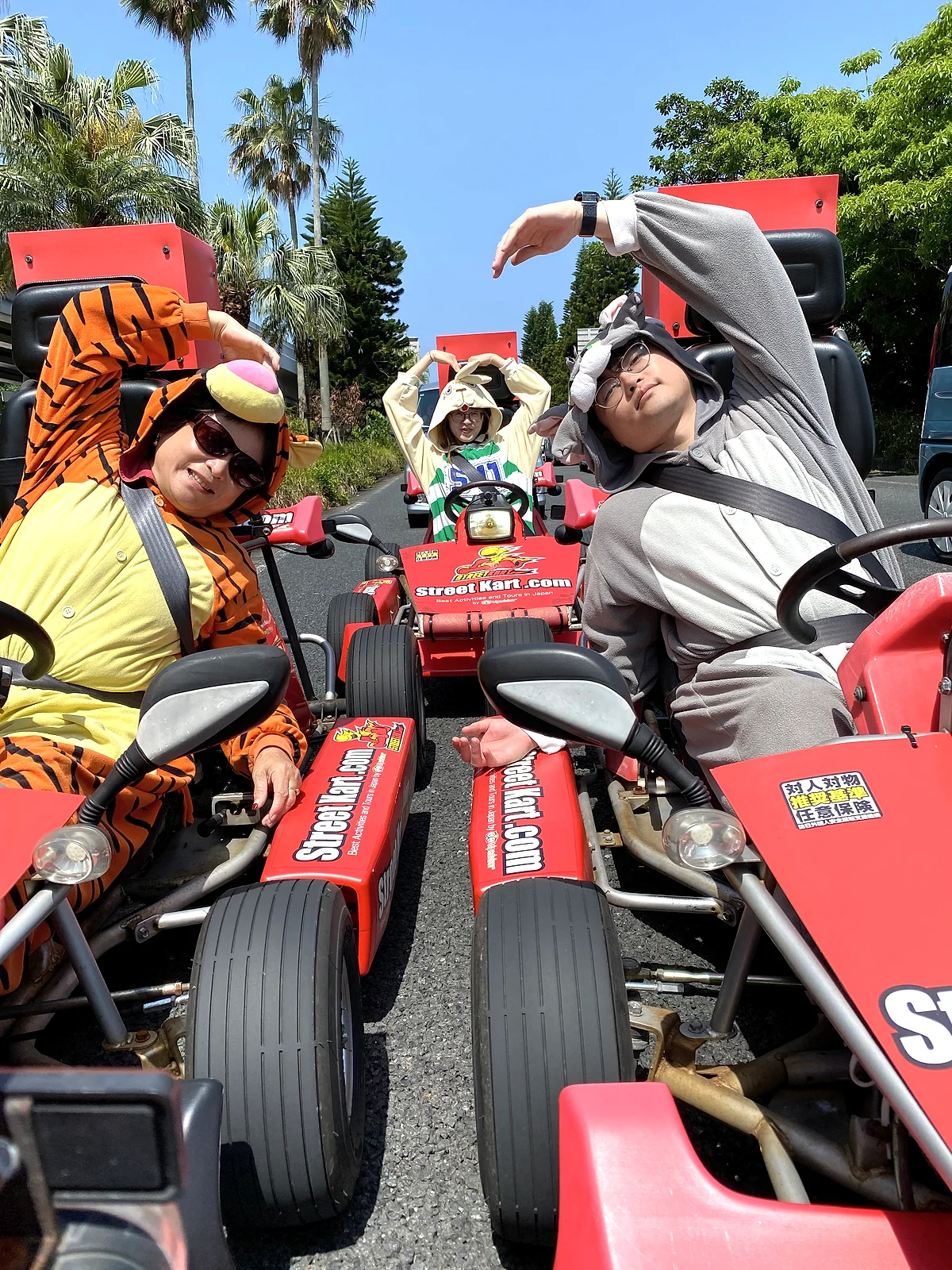
This time you don't have to look only at the scenery. Look at the back of the friend driving just ahead of you, and at their face when they turn around at a red light. This article follows the stretch from the streets of Naha out to the coastal road, told through the reactions of the people riding with you.
How do your friends' reactions change on the coastal road?
Think back for a moment to where you watched the Okinawan sea from last time.
From a rental car, there was a pane of glass between you and the water.
From the beach, the sea was a "view" spread out in front of you.
On a street kart, your distance from the sea changes. The seat is low, so guardrails and roadside shrubs sit right at eye level. There's no roof. The salt smell hits your nose, the sun hits your shoulders, and the wind hits your cheeks, all without anything in between. Behind the engine noise, you can hear the city too.
That's all I'll say about the kart itself.
What matters is that the same thing is happening to every one of your friends at the same moment, each on their own kart.
The karts are single-seaters, so you drive in a line, one behind another. Voices don't carry well. Instead, reactions show up in body language.
The moment you stop at a light, the friend in the kart ahead turns their head to the side. They raise one hand a little (within safe limits and following the guide's instructions, of course). Then they look back and shout something.
On the coastal road, these signals, clearer than words, keep coming one after another.
Honestly, this is a sight you didn't get on your first trip to Okinawa.
From central Naha to the sea: quick words at red lights
The tour departs from the Naha shop, with a guide leading the way. Routes vary by course, so if you'd like to know in advance where you'll go, check the official website.
While you're driving through central Naha, your friends are probably a little nervous.
On big streets like the one in front of the Prefectural Office, cars and buses pass right beside you. There's a light at every intersection. For a while after setting off, the back of the friend ahead of you looks a bit stiff.
You can sense it even in front of the shop before departure. The moment everyone pulls their goggles down, familiar faces suddenly look like strangers, and the group laughs a little. After the laughter, someone takes one deep breath. That's probably the person whose body will be most tense for the first few blocks.
That tension melts away over a series of red lights.
A friend who's been silent the whole time turns around at the second or third red light and says, "It's way lower than I expected!" That's how reactions gradually change.
The face in the middle of getting used to it is the best part.
On your first trip to Okinawa, you're too absorbed in the scenery to notice the expressions of the people next to you. On your second, you can leave half the scenery to your friends.
Near Naha Airport: why even friends who don't care about planes go quiet
One of the landmarks the tour passes is the area around Naha Airport. Seeing planes take off and land up close is what makes this stretch special.
The interesting part is the friends who have no interest in planes.
On your last trip, the airport was just "the place you arrive and leave from." You probably barely remember looking out the window. Now you're looking up at that same airport from just above the ground. The size of the aircraft feels completely different.
If you're into the outdoors, a comparison to waves makes this easy to grasp.
A wave you watch from the beach, and a wave you look up at while lying flat on a board. It's the same wave, but it looks like something else entirely. When your eye level changes, the size of things becomes something you feel in your body. The friend who went quiet by the airport is probably feeling exactly that.
If a plane passes nearby while you're stopped, sometimes you can see the head of the friend in front of you slowly tilting upward. The sound arrives first, and the aircraft comes into view after. Often the people who don't even care about getting a window seat are the ones who follow it with their eyes the longest.
No matter how amazing the sight is, though, don't take out your phone while driving.
Focus on the road ahead and the guide's signals. Take your photos before or after the tour, at your leisure. The excitement of the moment is far more fun to compare notes on with your friends once you're off the karts.
When the white buildings of Senaga Island come into view
If your course follows the coastal route, Senaga Island is where you'll have a moment of "this is different from last time."
Senaga Island is a small island south of Naha Airport, and it's one of the landmarks the tour passes. In front of an emerald-green sea stand the white buildings of Senaga Island Umikaji Terrace, a scene often described as Mediterranean.
Some of you probably ate ice cream at Umikaji Terrace last time.
Those people, more than anyone, will be surprised by how the island looks as you approach it from down low. From an angle different from walking up the slope or pulling into the parking lot by car, the white walls and the sea hit your eyes all at once.
This is also where your friends' reactions differ the most.
While you're driving, the friend ahead should have the sea in the corner of their eye the whole time. When you stop for a break, they're the first to turn toward the water. The friend behind you uses gestures at a red light to ask, "Did you see that?"
You're all supposed to be looking at the same scenery, yet everyone reacts to something different. Somehow, noticing that is fun.
If your course includes a break, there will probably be a round of laughter when friends take off their goggles and you see their wind-tangled hair. After that, try asking, "What was your favorite part?" Some will say the sea, some the white buildings, some that plane earlier. The more the answers split, the better the ride was, I think.
As the seasons change, so do the look of the sea and the strength of the sun. The scenery isn't the same no matter what month you go. For a second trip to Okinawa, it might be nice to choose a different season's sea from last time.
What happens by the sea, by type of travel companion
From here, let's imagine what's likely to happen depending on what kind of friend you bring.
Because who you go with turns the same road into a completely different memory.
First, the friend who says, "I've been to Okinawa a bunch of times."
Before departure, this person has a relaxed look on their face. The look of someone who already knows Kokusai Street and Naha Airport. But the more familiar a place is, the more clearly the difference in eye level shows. Surprisingly often, this person has the biggest reaction.
That "Huh?" face when familiar scenery appears from an unfamiliar angle.
It's worth inviting them just to see that.
Next, the friend who isn't confident about driving.
At first, they'll probably be so focused on the distance to the kart in front that the scenery won't even register. Tell them not to push themselves and to go at their own pace. The guide leads, so there's no need to memorize the route.
A friend who was doing all they could just to keep up suddenly looks up around the time you reach the coast.
If you get to see that moment from behind, it's a real joy for the one who invited them.
The friend who loves photography will be thinking "I want to shoot here" the whole drive. But you can't take photos while driving.
So after the tour, this type is the one who talks in the most detail about what was good. "That angle near the airport." "The first few seconds when the island came into view." Their memories become the shot list for your next trip.
Then there are friends who love the ocean, like surfers and divers.
They're sensitive to the smell of salt and the direction of the wind, and the moment you reach the coast, they get a look like they're picking up a scent. On this route, the city, the sea, and the airport are packed close together. The feeling of the sea sitting right next to the city looks fresh even to people who spend a lot of time in the ocean.
Finally, the friend who planned this trip.
The person who has handled lodging and transportation has been watching the clock and the map the whole trip. But on the kart, the guide in front decides the route. For the first time on this trip, they get time when they can let go of the logistics. If you see their shoulders drop around the time you reach the coast, you'll be glad you invited them.
What all these types have in common is that their reactions often don't turn into words.
So remember where your friends looked back, and where they went quiet.
Later, when you ask, "What were you looking at back then?" you'll get a slightly different answer every time.
How Street Kart works, and what to know before you go
This time by the sea is made possible by how the Street Kart tour works. Let's go through a few points in order.
First: on every tour, a trained guide drives at the front. Even on Naha roads you've never driven, the guide ahead shows you where to turn and where to stop. Since you don't have to worry about remembering the route, you have room to watch your friends at red lights and during breaks.
Second: guidance on the day of the tour is basically in English. Guidance in Japanese or other languages depends on the staff that day and is not guaranteed. If you have any concerns about language, check the official website before you go, and on the day, keep your eyes on the guide's signals and your friends' faces when you stop.
Third: the Okinawa shop is in Naha. The places you pass vary by course, but there's the city side, like Kokusai Street, and the seaside, like Naha Airport and Senaga Island. As you move from the city to the sea, your friends' reactions change too. That change is what this article has been following.
Driver's license requirements differ by country and license type. Check the latest requirements for everyone in your group on the Street Kart official website before you go. Participation fees vary by season and time of day, so check the official site (kart.st) for the latest information as well.
Before and after the tour: sea time with friends within walking distance
The time after you get off the karts is perfect for looking back on your friends' reactions.
Since you couldn't talk while driving, conversation flows once you're off. Here are some ways to continue the day at places within walking distance of the Naha shop. None of these are part of the tour route; they're places you can stop by before or after.
Naminoue Beach, about a 20-minute walk from the shop, is where you can go check out the sea you saw from the coastal road, this time on your own feet.
The sea seen from a low kart, and the sea seen standing on the sand. Stand side by side with your friends and talk about what was different.
When you leave, just take home whatever trash you brought. Do that, and the same sea will be waiting next time you come.
Also about a 20-minute walk away is Tomari Iyumachi, a spot with a fish market and eateries.
After a dose of sea breeze, seafood hits the spot. Over plates of fish, swap reports on who reacted to what during the drive. The tastiest second half of the tour happens here.
Often, the person who stayed silent the longest on the kart doesn't realize it themselves. In those cases, the testimony of whoever was driving behind them is what you rely on.
If you'd rather spend some time in town, Kokusai Street and Makishi Public Market are about a 10-minute walk away. If your course goes along Kokusai Street, you can compare the low kart view with the walking view one more time.
Browsing pottery along Yachimun Street, about 15 minutes on foot, is also a nice way to slowly cool down.
After the excitement by the sea, a walk down quiet back streets.
Not a bad way to end the day, I think.
For clothing, it helps to plan for both sun and wind. In summer, sunscreen, a hat, and sunglasses come in handy. Closed-toe shoes like sneakers are recommended. So you don't end up showing up in sandals after the beach, it's a good idea to pack a pair in your bag. Check the official website in advance for rules on clothing and what to bring.
On your next Okinawa trip, leave half the scenery to your friends
If what you're looking for on your second trip to Okinawa is "a different way to enjoy it than last time," the answer isn't a new place but a new perspective.
From the streets of Naha to the sea.
From the sky over the airport to the white walls of Senaga Island.
On that road, the friend ahead turns to look back. The friend behind raises a hand.
Those moments stay with you as much as the scenery does.
When you look back through your photos after the trip, what you remember may not be the color of the sea, but your friend's laughing face behind their goggles as they turned around at a red light.
Street Kart takes reservations via Facebook, LINE, and email. Contact details and full tour information are on the Street Kart official website. Weekends tend to fill up, so once you've set dates with your friends, it's a good idea to get in touch early.
On your next trip to Okinawa, before you take the wheel, think about who you'll invite.
Where will they look back?
A trip to go see that wouldn't be bad at all.
This article was originally written in Japanese and translated using AI. Some expressions may read unnaturally, and we appreciate your understanding. For the most accurate and up-to-date information, please refer to the official site at kart.st.
Street Kart is not affiliated with Nintendo or the Mario Kart series in any way. We do not provide costumes of Nintendo characters, and such costumes may not be worn during tours even if brought by participants.