
Is Cloudy Okinawa Actually Easier to Photograph? A Second Street Kart Trip and Naha Subjects to Shoot Before and After Your Tour
Is Cloudy Okinawa Actually Easier to Photograph? A Second Street Kart Trip and Naha Subjects to Shoot Before and After Your Tour
I take my time looking back through the photos from my last trip to Okinawa.
Deep blue sea. Pure white clouds. Every shot is dazzling, and they all look a little alike.
They're still good memories.
Now it's your second time in Okinawa. You open the hotel curtains and the whole sky is gray. On a morning like that, your shoulders might sag a little.
But for anyone who takes photos, it isn't a bad morning.
The light is soft. The shadows stay calm. Colors settle down, and the real texture of skin, walls, and the sea comes through. Things that got washed out to white on a sunny day show up properly on a cloudy one.
This is for people who have already driven around Okinawa once with Street Kart.
This time, why not head out to shoot with the clouds on your side?
Why Do Sunny-Day Okinawa Photos All End Up Looking Alike?
Okinawa's clear skies are tough on photos.
The sun is so strong that the gap between bright and dark areas is huge. White buildings blow out to pure white, and the shade under trees sinks to black. A hat brim casts a sharp shadow across people's faces.
On top of that, no matter who's holding the camera, everyone gets drawn into the same composition: "blue sea and blue sky."
People often say the beach at midday is a photographer's nightmare.
The fine patterns on the surface of the waves and the shifting gradients of color in the water come out quietly and clearly when the sun isn't glaring.
In photography, an overcast sky is often described as "the whole sky turning into a giant diffuser," a panel that spreads light out.
Light wraps around from every direction, so shadows are soft. Contrast is gentle, so even a smartphone camera is less likely to blow out highlights or crush shadows.
The things you couldn't capture on your first trip:
Texture. Subtle differences in color. People's expressions.
On a cloudy day, they come through just as they are.
If this is your second trip, you probably already have your blue-sea photos.
So this time, try bringing home a cloudy-day Okinawa. Your album gains a page nobody has opened yet.
What Looks Different When You Drive Through Cloudy Naha with Street Kart?
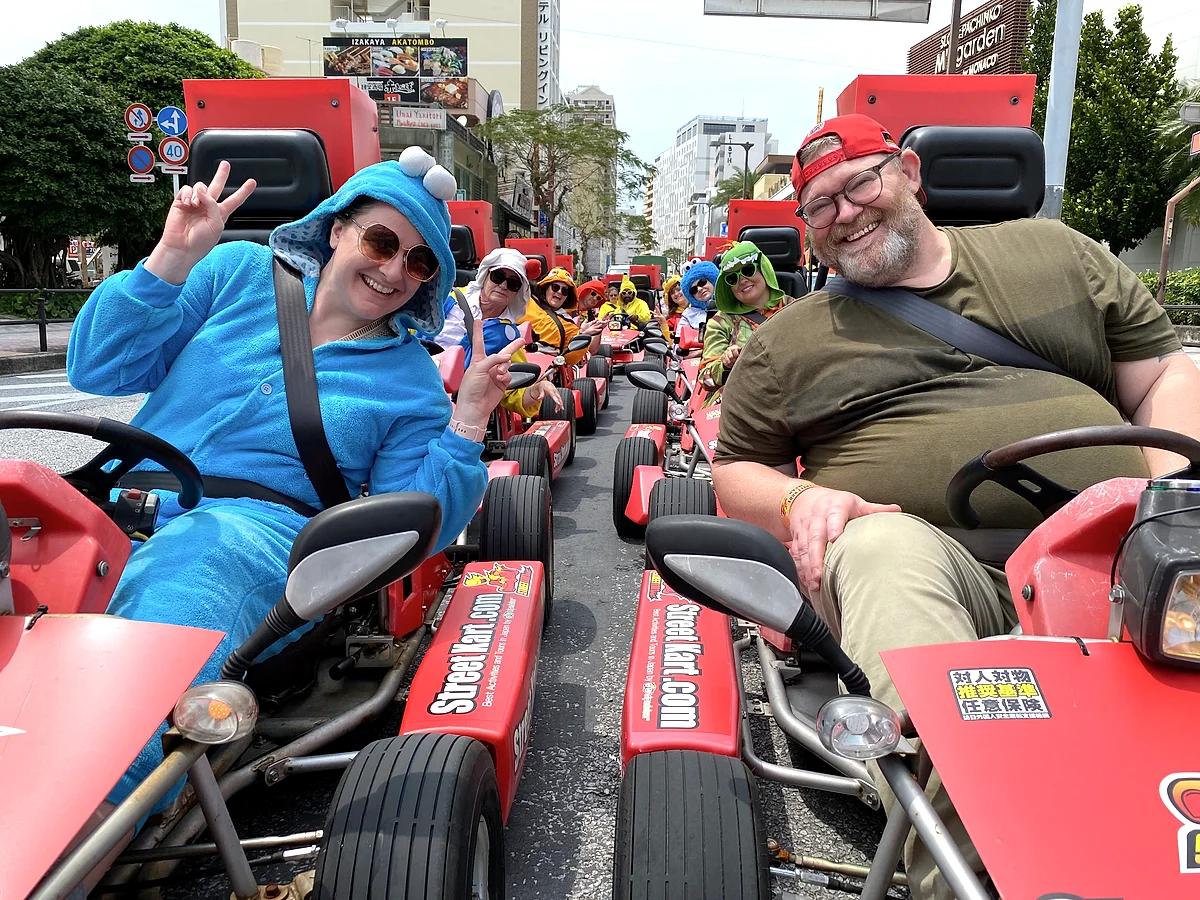
Street Kart tours are led by a guide who drives in front.
Routes from the Okinawa (Naha) store include places like Kokusai Street, the area in front of the Prefectural Office, around Naha Airport, Senaga Island, and coastal roads. Where you go depends on the course, so if there's a spot you're curious about, it's a good idea to check the official website beforehand.
One thing before we go further:
Don't operate your phone or camera while driving.
Both hands on the wheel. Eyes on the road ahead and on your guide's back.
Take photos before or after the tour, or when you're stopped and the guide says it's OK. That's plenty.
So what changes on a cloudy-day tour?
What changes is the scenery you see with your own eyes.
Take a good look at it, and the photos you take later will change too.
On a sunny day, the signs and shop curtains on Kokusai Street tend to get lost in backlight and harsh shadows.
On a cloudy day, the red, yellow, and green signs stand out clearly, one by one. Because the sky is gray, the colors of the city rise to the surface.
The white buildings on Senaga Island are the same.
On a clear day, they're so bright you have to squint. On a cloudy day, you can actually see the texture of the walls and the shadows of the stairs.
The sea is different too.
It shows a different face from the emerald green of a sunny day. Within a dull, silvery light, hints of blue-green show through here and there.
Looking at that sea, you think, "This is today's sea." Personally, I like that expression a little more.
Around Naha Airport, you can watch planes taking off and landing.
Against the gray sky, the silhouette of an aircraft slowly crosses overhead. It has a different weight than on a blue-sky day.
Save the plane-watching for before or after the tour, once you've stepped out of the kart.
On your second tour, I recommend thinking back on the scenes that stayed with you after you finish driving and get out of the kart.
"Where could I shoot that view from later?"
While you're driving, focus on the road ahead and your guide's back. Think about where to shoot after you're done.
That's how to make the most of a cloudy-day kart trip.
What Makes Street Kart Fun: Things You Notice the Second Time
If you've ridden once, your body probably remembers how fun the karts are.
A body with no roof. The sounds and breeze of the city, arriving along with the vibration of the engine.
That doesn't change with the weather.
But on a cloudy day, you don't have to squint into the sun. The streetscape beyond the guide in front of you seems to come in without glare getting in the way. Save the long, careful look at the scenery for after you get out of the kart.
What you notice the second time might be that the guide is right there in front of you.
The first time, just keeping up took everything you had. The second time, you start to pick up the signals from the guide ahead and the rhythm of the whole group.
You drive a familiar road with your shoulders a little more relaxed.
That extra room is what gives you an eye for the scenery.
Driving with friends is another joy of the tour.
If you joined alone last time, this time you might invite your travel companions. On a cloudy day, harsh shadows are less likely to fall across everyone's faces, so your post-tour group photo comes out more natural than usual.
Once the group photo is done, grab your camera and head into town.
4 Naha Subjects to Shoot Before and After Your Tour, Precisely Because It's Cloudy
From here on, this is separate from the tour.
These are photo spots to visit on foot or by other transportation before or after your tour. Once you're out of the kart, take your time and explore them on your own two feet.
Tsuboya Yachimun Street: Pottery Glazes Show Their True Colors on Cloudy Days
About a 15-minute walk from the store. Tsuboya Yachimun Street is lined with pottery shops and cafés.
Okinawan pottery, called "yachimun," leaves an impression with its chunky thickness and its deep indigo and amber glazes.
Shoot it in front of a shop on a sunny day, and the glaze shines with glare and the colors wash out.
A cloudy day is different.
The soft light calms the gloss of the glaze. The true color of the piece and the bumps you'd feel running a finger over it come through just as they are.
When you shoot, get close to the piece at a slight angle and try including cobblestones or an old wall in the background.
When photographing a shop's pottery, don't forget to ask first and get permission.
About a 10-minute walk from the store, right on Kokusai Street, the area around Makishi Public Market is full of color.
The blues and oranges of the fish. Fruit. Dried goods. Handwritten price tags.
If the red and yellow signs stuck with you when you drove down Kokusai Street on the tour, look for those colors in the handwritten price tags and shopfronts around the market. The colors of the city you saw from the kart can become a clue for a shot you take after you get out.
On sunny days, the contrast between sun and shade tends to plunge half the frame into darkness. On cloudy days, everything is evenly bright, so it's easier to fit all the cluttered bustle into a single shot.
It's a crowded place, so take your photos quickly and don't block the aisles.
Be considerate when people's faces end up in the frame. If you want to photograph food or merchandise, ask the shop staff first.
Naminoue Beach and Naminoue Shrine: A Gray Sea and a Seaside Shrine
About a 20-minute walk from the store. Naminoue Beach is a beach right in Naha City. Naminoue Shrine stands nearby.
On a clear day, it makes the classic shot of blue sea and shrine.
On a cloudy day, the mood changes completely.
The line between sky and sea blurs. Only the line of the water's edge quietly remains. A shot that feels a little lonely, yet one you'll want to look back at again and again.
On days like this, the trick is to reduce how much sky is in the frame.
If you include a wide stretch of gray sky, the whole photo looks dull. Make the water's edge, the sandy beach, or the shrine roof fairly large, and leave just a sliver of sky at the top.
After shooting, take your trash home with you.
If the beach has let you enjoy yourself, leave it a little cleaner than you found it.
I think the sea can feel that, too.
About a 20-minute walk from the store. Tomari Iyumachi is a place with a fish market and eateries.
Silvery fish. Ice. Wet floors.
Subjects with lots of "shiny things" like these are hard to handle in direct sunlight because the reflections are too harsh.
On a cloudy day, every single fish scale comes out soft.
After shooting, you can eat seafood right there at the eatery and relax until your tour.
That's not a bad way to spend the time.
4 Tips to Avoid Mistakes with Your Smartphone or Camera on Cloudy Days
Cloudy-day photos are easier to take.
But if you shoot without thinking, you tend to end up with "a somewhat dark, dull photo." A little effort makes a big difference.
First, raise the brightness just a bit.
On a smartphone, tap the screen and then nudge the brightness slider up slightly. On a camera, dial the exposure compensation a little toward the plus side. On cloudy days, the camera tends to decide "it's a dark day" and darken the whole image.
If white walls or white sand come out grayish, that's a sign you haven't raised it enough.
Second, as I mentioned earlier, don't include too much sky.
An overcast sky is a gray surface with little information. If it takes up half the frame, the photo looks hazy. Point the camera down a little and put your subject on the ground, a wall, or the surface of the sea to tighten things up.
Third, adjust the color.
If your camera has a "cloudy" white balance setting, try using it. The photo shifts slightly warmer, softening the coldness of the gray. On a smartphone, just warming the color temperature a touch when editing afterward changes the whole atmosphere.
Fourth, try shooting people straight on.
On sunny days, you have to think about where the sun is, and finding the right spot takes time. On cloudy days, faces tend to look good from any direction, so you can snap your friends quickly.
Do it right after the tour, while their cheeks are still a little flushed. You can capture those smiles just as they are.
If you have an action camera, check in advance whether you're allowed to use it during the tour.
Don't make the call yourself on the day if you're unsure. Confirm through the official website or when you inquire at booking.
Things to Check Before Heading Out on a Cloudy Day
For how tours are handled on days when the weather looks like it might turn, check the information on the official website.
Cloudy and rainy are different stories, and some days are windy.
Don't read the weather the way that suits you. Check the forecast, and if you're unsure, follow the official information.
That's the way to enjoy yourself with peace of mind.
About what to wear:
Even on cloudy days, Okinawa's humidity is no joke. Bring quick-drying clothes and one thin, wind-resistant layer. That alone makes things more comfortable, both while driving and while walking around taking photos.
UV rays still get through when it's cloudy, so wear sunscreen just as you would on a sunny day.
Guidance on tour day is basically in English. Guidance in Japanese or other languages depends on the staff that day and isn't guaranteed. If you have any concerns, contacting them in advance will help you go into the day feeling settled.
Also, the website is available in 22 languages.
For details, please check the Street Kart official website (kart.st).
Reservations are accepted via Facebook, LINE, and email. See the official website for details.
Weekends tend to fill up, so it's best to get in touch early.
Rather than scrambling to find a spot after checking the forecast, book first and take the attitude of "if it's cloudy, so be it."
That way, your whole trip feels more relaxed.
On Your Second Trip to Okinawa, You Don't Have to Be at the Mercy of the Sky
On a first trip to Okinawa, you can't help riding the highs and lows of the sky's color.
Sunny means you won. Cloudy means you lost.
But on your second trip, you can quietly let go of that yardstick.
Kokusai Street, where the colors of the signs rise up under a gray sky.
Senaga Island, where the glare fades and the texture of the walls emerges.
Tsuboya pottery, where the deep colors of the glaze quietly shine.
These are all scenes that only show their faces beneath the clouds.
Grip the kart's steering wheel and drive through cloudy Naha. Burn the scenery into your memory.
Then pick up your camera and walk the same city once more.
A different Okinawa from last time should start filling the new pages of your album.
When a cloud icon shows up in the forecast,
before you get disappointed, check your camera battery.
For the latest tour information, visit the Street Kart official website.
This article was originally written in Japanese and translated using AI. Some expressions may read unnaturally, and we appreciate your understanding. For the most accurate and up-to-date information, please refer to the official site at kart.st.
Street Kart is not affiliated with Nintendo or the Mario Kart series in any way. We do not provide costumes of Nintendo characters, and such costumes may not be worn during tours even if brought by participants.