
You've Stepped Out of the Kart in Okinawa. Now Where? How to Pick a Naha Side Trip by the Brightness of the Sky
You've Stepped Out of the Kart in Okinawa. Now Where? How to Pick a Naha Side Trip by the Brightness of the Sky
The engine cuts out.
The sound of the wind still echoes in your ears. Your hands are off the steering wheel, but your fingertips still seem to be leaning forward.
After you climb out of the kart in Naha, you might find yourself standing still for a moment, wondering what to do next.
You already walked Kokusai Street on your last trip to Okinawa. You already bought the purple sweet potato tarts. Retracing the same route again feels like a bit of a waste.
This article is for people like that. It's about how to choose where to go next. Not by picking from a list of places.
Instead, you look at how bright the sky is when you step out of the kart, and let that decide where you go.
Choose Your Side Trip by the Sky, Not the Clock
To be honest, if you plan your next move based only on "what time will this end," you'll often get it wrong in Okinawa.
Summer and winter get dark at very different times. Even at the same hour, the thickness of the clouds alone can change how the city looks.
So the guide isn't the time. It's how bright the sky is when you get out.
Put two things side by side: the scheduled end time of your booked slot, and that day's sunset time. That alone narrows down your options a lot.
On cloudy or rainy days, the sky gets dark early, even before sunset. Even if the clock says it should still be light, trust the color of the sky you see when you look up after stepping out.
On days like that, add one indoor option to your list so you don't get stuck. Within walking distance there's the Makishi Public Market and Blue Seal on Kokusai Street. If you're going by car, there's also Naha Main Place and AEON Naha. None of them depend on the sky's mood.
By the way, tours run as scheduled in light to moderate rain. Raincoats are provided free of charge. Tours are canceled in heavy rain or typhoons, and in that case you can choose from options such as a shortened tour, rescheduling, or a refund.
There's one more thing worth checking: your own body, right after you get out.
After riding an open-air vehicle through the sea breeze, your hair and clothes will smell of salt. You'll be thirsty. In the hot season, you'll probably be sweaty too.
What your body wants after coming in from the sea is pretty predictable. A cold drink and a place to sit. And then a little more fresh air.
In Naha, all of these are either within walking distance of the shop in Higashimachi or a short car ride away.
One thing I should mention up front.
Tours follow a set route for each shop, led by a guide. Every side trip in this article is something you do after the tour ends and you've returned to the shop.
The shop has no parking. Please use public transportation such as the Yui Rail to get there. After the tour, it's easiest to plan on getting around on foot, by taxi, or on the Yui Rail.
Think about your luggage before your side trip, too. The shop has lockers for small items, but they aren't suited to large bags like suitcases. On days when you come straight from the airport or change hotels, drop off your big luggage at your accommodation first. You'll move more freely after the ride.
What Makes Street Kart Special: Naha Looks Different After the Ride
Before the side trips, here's a quick summary of what driving a kart through Naha leaves you with.
First, you sit low.
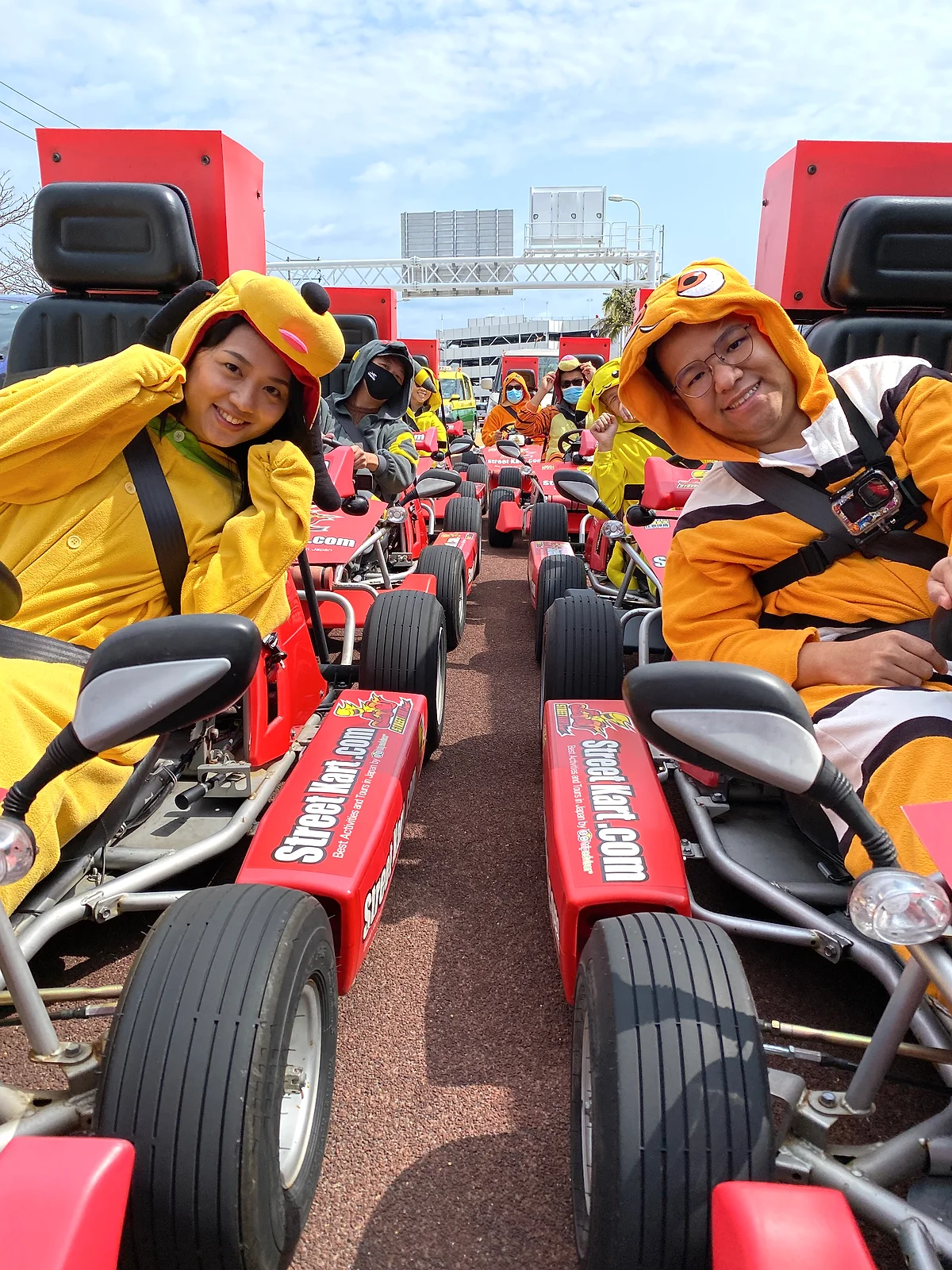
The seat is close to the ground, and there's no roof. The city that usually slides past behind a car window is moving right beside you. Music drifting from storefronts while you wait at a light. A sudden whiff of sea air from beyond the intersection.
You take in a lot with your whole body.
Second, there's the sea.
Depending on the course, you'll drive to Senaga Island, south of Naha Airport, and along the coastal roads around it. The white buildings of Senagajima Umikaji Terrace sit beside the emerald-green sea. Near Naha Airport, you can feel the size of the planes taking off and landing right up close.
It's less that you look up at them and more that their size makes you look up.
Third, a guide drives in front of you.
At Street Kart, a trained guide leads the way. You follow the back in front of you and can keep your eyes on the scenery. In a place I'd never been before, I was grateful for that.
Fourth, language.
The official website is available in 22 languages. On the day of the tour, however, guidance is basically in English. Whether you can get guidance in Japanese or other languages depends on the staff that day and isn't guaranteed. If you're concerned, contact them in advance so you can go into the day feeling relaxed.
Fifth, what's been built up over the years.
As of November 2023, across all shops combined, they had run more than 150,000 tours, served more than 1.34 million customers, and received more than 20,000 reviews. The average rating was 4.9 out of 5.
These numbers are a little old. Still, it feels a bit strange to think that so many people have driven through the city from this same low vantage point.
Sixth, the city's map settles into your body.
When you walk through Naha after the kart ride, there are moments when you think, "I drove past there earlier." Places you only knew as isolated dots on your last trip slowly connect into lines.
That's probably what changes most on a second trip to Okinawa.
If a shop or a corner caught your eye during the ride, mark it in your map app as soon as you get back to the shop. You'll want to focus on driving while you're out, so do it while it's still fresh. Those pins become your side-trip options.
Route details and participation requirements may change. Please check the latest information on the Street Kart official website.
Naha Side Trips by Brightness
If You Get Out While It's Still Light: Walk to the Pottery Street and the Market
If the sun is still high, I'd suggest places you can walk to.
About 15 minutes on foot from the shop is Yachimun Street (Tsuboya), lined with shops selling yachimun, Okinawan pottery, as well as cafés.
You leave the busy streets and turn onto this one. The city noise fades a little. After the wind has left your body flushed, the quiet feels just right.
I recommend choosing pottery while it's still light. Glaze colors look quite different in natural light than under shop lighting.
It's also worth thinking about when to buy. You can only carry a smallish bag on the kart. With fragile things like yachimun, it's easier to take your time choosing after you've finished driving.
If you take photos, shoot the pottery displayed in front of the shops from an angle where the light hits it from the side. The small bumps on the surface stand out. The softer the light gets toward evening, the better the colors come out.
About 10 minutes on foot from the shop are the Makishi Public Market and Ichiba Hondori.
Just one street off Kokusai Street, the atmosphere changes. At the First Makishi Public Market, you can buy Okinawan ingredients at the market and have them cooked for you on the second floor. If you're hungry after the kart ride, this is a good place to sit down.
Even if you walked Kokusai Street last time, coming in from the market side might make a city you thought you knew look a little different.
If you can walk a bit farther, Tomari Iyumachi, about 20 minutes on foot from the shop, is another option. It has a fish market and restaurants. Check the opening hours before you go so you don't make the trip for nothing.
If you're getting around on foot, a word about shoes. Closed-toe shoes or sneakers are recommended for the kart. Considering how much you'll walk on your side trip, wearing a pair you're used to makes things easier.
When the Sky Starts to Change Color: Head Toward the Sea
If sunset is near, I think the sea is the place to go.
Within walking distance is Naminoue Beach, about 20 minutes from the shop. It's a beach inside Naha city, with Naminoue Shrine right next to it.
You don't need to be ready to swim. Just sit on the sand and watch the sky change color. That's enough.
It's different from the strong wind you felt in the kart. What blows here is a slow sea breeze.
Take all your trash home with you. Whether it's Shonan or Okinawa, a plastic bottle left on the sand will eventually be carried out to sea by the waves. Before you leave the beach, take one look around where you were sitting. That small step protects the view for the next person.
If you want to go farther, there's Senaga Island, about 15 minutes by car from the shop.
Buy an ice cream at Blue Seal on Senaga Island and wait for the sunset. That alone makes a side trip.
If your tour passed by Senaga Island, this time you'll be standing on it yourself. The sea you glanced at from the side while driving, you now look at head-on, slowly. It's the same sea, but it looks different.
The O-M course, which passes Senaga Island, is listed as having a sunset-viewing option. If you want to see the evening sky while driving, check the details on the official website before booking.
Toyosaki Chura-SUN Beach, about 20 minutes by car, is another evening option. If you're taking a taxi, leave with plenty of time before sunset.
You can also plan things in reverse. Spend the morning at the beach, shower and change, then get in the kart. After you get out, go back to the sea to watch the sunset. It's a day framed by the sea on both ends. Allow extra time for changing so you won't be rushed.
When photographing a sunset, it works better not to aim at the sun itself. Your friends silhouetted black against the light. A band of light stretching straight across the water. Setting the exposure a little negative keeps the sky's colors from washing out to white. This works on a smartphone too.
Even after the sun drops below the horizon, don't leave right away. Stay a little longer. The sky changes color once more from there. After the orange fades come pale purples and deep blues. Sometimes that sticks in your memory more than the sunset photos do.
If It's Already Dark When You Get Out: End the Day on a Lit-Up Street
What if it's already dark when you get out?
I'd say don't push yourself to go far. After riding outdoors in the wind, your body is more tired than you think.
Kokusai Street, about 10 minutes on foot, takes on a different look at night, with the street lit by shop lights. It's a street I'd especially like people who only walked it during the day last time to try at night.
If you take photos of Kokusai Street at night, try lightly tapping a bright part of a sign on your smartphone screen. The brightness adjusts to that spot, and the colors of the sign are less likely to get lost. If you want to include the flow of people, move to the edge of the street and shoot from a spot where you won't get in anyone's way.
For dinner, there's Okinawan cuisine at Urizun on Kokusai Street. For Okinawa soba, there's Tondo, and for tonkotsu ramen, there's Danbo. If you want to pick up more souvenirs, you can also stop by Okinawaya or Okashigoten on the same street.
If you still have energy left and feel like steak, there's Sam's Anchor Inn, about 15 minutes by car, or Jack's Steak House, about 20 minutes away. Adding a different kind of Okinawan night from last time could be nice.
Mihama American Village, about 40 minutes by car, is a bit far to go after the kart. Saving it for another day leaves you more breathing room.
To make evening side trips easier, it helps to think about where you're staying at the same time.
Hyatt Regency Naha Okinawa is about a 5-minute walk from the shop. If you stay there, you can walk straight back after your evening side trip.
Once you're back in your room, try tracing the roads you drove today on your smartphone map. That intersection, that coastal road. Tracing them with your finger brings the daytime wind back again. You might find tomorrow's side-trip options there too.
On the streets at night, watch your step and watch out for cars. Road surfaces are especially slippery after rain.
Before Booking, Decide on Your Side-Trip Options Too
Before you book the experience, look up the sunset time for the day of your trip.
Then, based on how bright the sky will be around the end of your slot, think of one or two places to go.
If it's still light: Yachimun Street and the market. If it's evening: Naminoue Beach or Senaga Island. If it's dark: Kokusai Street.
Decide this much, and you won't be left wondering after you get out.
Besides sunset time, checking two more things will put your mind at ease.
The first is the weather forecast the day before. If cloudy or rainy weather is forecast, add one indoor option to your list.
The second is your plans for the next day. If you have an early morning, keep your evening side trip to Kokusai Street, which you can walk to. It's a line you draw so you don't carry fatigue into the second half of your trip.
For clothing, it's a good idea to bring a light layer. Riding in the wind can chill you, and it can get cooler by the sea in the evening.
Weekends tend to book up, so if you want to ride on a weekend, I recommend booking early. Reservations are accepted via Facebook, LINE, and email. Please check the Street Kart official website for contact details, the latest information, and the license requirements for driving.
You step out of the kart and take off your helmet.
At that moment, is the sky still blue? Is it starting to turn orange? Or is it already dark?
That color will quietly tell you where to head next in Naha today.
This article was originally written in Japanese and translated using AI. Some expressions may read unnaturally, and we appreciate your understanding. For the most accurate and up-to-date information, please refer to the official site at kart.st.
Street Kart is not affiliated with Nintendo or the Mario Kart series in any way. We do not provide costumes of Nintendo characters, and such costumes may not be worn during tours even if brought by participants.